
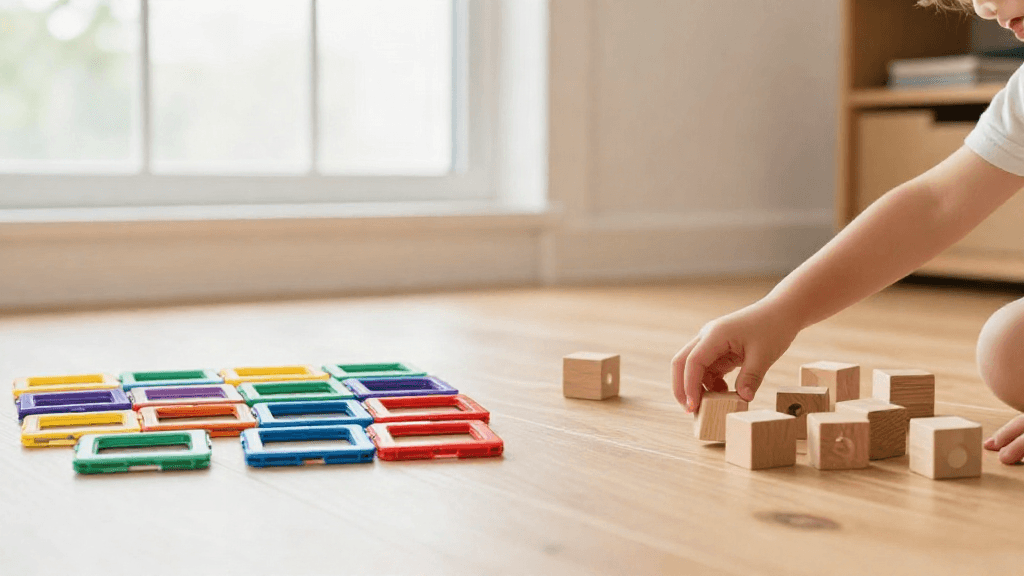
Magnetic Tiles vs Wooden Blocks: Which Building Toy Suits Your Child?
Both toys sit on the same shelf. Both get picked up on the same afternoon. And yet magnetic tiles and wooden blocks ask your child to play in two completely different ways. If you are deciding where to spend your money, or you simply want to know what your child is learning while they build, this side-by-side comparison is for you.
The good news: you do not have to pick a side forever. More on that later.
The Short Answer
Magnetic tiles win on fast, forgiving building and early geometry. Wooden blocks win on patience, balance and open-ended pretend play. There is no single "better" toy - there is only the better fit for your child's age, temperament and stage of development. Most families end up wanting both.
How Each Toy Builds Different Skills
Open-ended building toys are some of the best value playthings you can own, because the child - not the toy - decides what happens next. That said, the two types pull different muscles.
What magnetic tiles teach
Magnetic tiles snap together, so the connection does the hard work. A three-year-old can build a tall tower, a cube or a simple house without perfect hand control.
Cause and effect: attach, detach, rebuild in seconds.
Early maths and geometry: squares, triangles, symmetry and how shapes combine.
Confidence: a satisfying result with very little frustration.
Colour and light play: tiles feel bright and almost magical to young children.
Because the pieces click, the play is quick and low-risk. That is exactly what toddlers and preschoolers need.
What wooden blocks teach
Wooden blocks do not hold on to each other. Gravity and balance decide everything, and that changes the challenge.
Fine motor control: careful stacking, steady hands and patience.
Problem solving: a tower falls, so the child works out why.
Pretend play: a block becomes a phone, a bridge, a slice of cake or a garage.
Focus: wooden play tends to be slower, calmer and longer-lasting.
If magnetic tiles feel like instant reward, wooden blocks feel like earned reward. Both matter.
Safety and Durability: A Side-by-Side Look
Safety is where many parents start, and it is worth checking the actual toy in your hand rather than the category.
Magnetic tiles: quality matters most here. Strong, fully sealed magnets inside a sturdy plastic shell are the standard to look for. Cheap tiles with weak seals do not belong in a home with curious toddlers, so buy from brands that state their safety testing openly.
Wooden blocks: choose solid wood with smooth, splinter-free edges and non-toxic, water-based paint. Wood is naturally tough and ages well - a good set can pass from one child to the next.
Durability: wooden blocks are almost indestructible. Magnetic tiles are durable but can crack under heavy impact, and a cracked shell means the tile must be replaced. Handle both with care and either set can last for years.
Value for Money: What You Actually Pay
This is the part that surprises parents. A quality set of magnetic tiles or a large wooden block set is not cheap to buy outright - and children outgrow toys quickly. A four-year-old who loves magnetic tiles today may be obsessed with something entirely different next season.
That is why more families are switching to toy subscriptions instead of buying. With a toy library, the cost of a single toy is spread across hundreds of options, and the toy goes back when your child has finished with it.
At the EleFant, families across 18+ cities have placed over 2.5 lakh orders, with 1.8 lakh+ registered users and 125+ partners. A Mini Plan gives access to 1,000+ premium, sanitised toys and books - two toys at a time for 12 months at ₹3,600, which works out to ₹300 a month. Every toy is cleaned and safety-checked between homes, with free delivery and pickup, unlimited swaps and a 100% damage waiver.
Which One by Age?
Under 2: large, chunky pieces only. Soft and simple wooden blocks are usually the safer first step, always with an adult nearby.
Ages 2 to 3: magnetic tiles are a brilliant match here - quick wins, big shapes, lots of colour and very little frustration.
Ages 3 to 5: this is the golden window for both. Tiles for building and maths, wooden blocks for pretend play and storytelling.
Ages 5 and up: wooden blocks and larger construction sets keep challenging planning and creativity, while tiles support more advanced structures.
A simple rule: buy or borrow for the child you have today, then rotate as they grow.
The Case for Trying Both Without Buying Both
Here is the honest answer to the whole comparison. Most children do not need one or the other - they need the right toy at the right moment. The problem is that buying both is expensive, and the toys pile up once the interest fades.
A toy subscription removes that pressure. You borrow a magnetic tile set this month, swap it for wooden blocks next month, and let your child discover which one they truly love. No clutter, no wasted money, no arguing over which is better.
Final Thoughts
Magnetic tiles versus wooden blocks is not really a contest. Tiles teach fast building, geometry and confidence. Wooden blocks teach patience, balance and imagination. The winning move is not choosing between them - it is making sure your child gets time with both, without a house full of unused toys.
Subscribe Now and let your child try, swap and grow through the world of building toys, one delivery at a time.