



If your child has a room full of toys but still whines that they're "bored," you don't have a toy problem. You have a too-many-toys-at-once problem. Toy rotation is the simple fix: instead of leaving every toy out all the time, you keep a small set available and swap it for a fresh set every week or two. Fewer choices, more focus, and a child who actually plays with what's in front of them.
Here's exactly how to do toy rotation at home, why it works, and how to make it stick without turning your living room into a storage warehouse.
What is toy rotation, really?
Toy rotation means dividing your child's toys into a few groups, putting most of them away out of sight, and bringing a small selection in and out on a schedule. Think of it like a restaurant menu versus a buffet. A buffet with fifty dishes leaves you overwhelmed and picking at everything; a short menu of six good options helps you actually choose and enjoy.
Children work the same way. When every toy is out at once, all those choices overwhelm them, and they jump from one thing to the next without settling into real play. According to NIH an experiment proved that when you give a child fewer toys and they play deeper, longer, and more creatively with each one.
Why toy rotation works so well
Two things are happening when you rotate toys, and both are worth understanding.
A break makes old toys feel new again. A toy that's been sitting out for a month stops getting noticed, and your child plays around it without really seeing it. Put it away for two weeks and bring it back, and it feels almost new. You get the excitement of a "new" toy without buying anything.
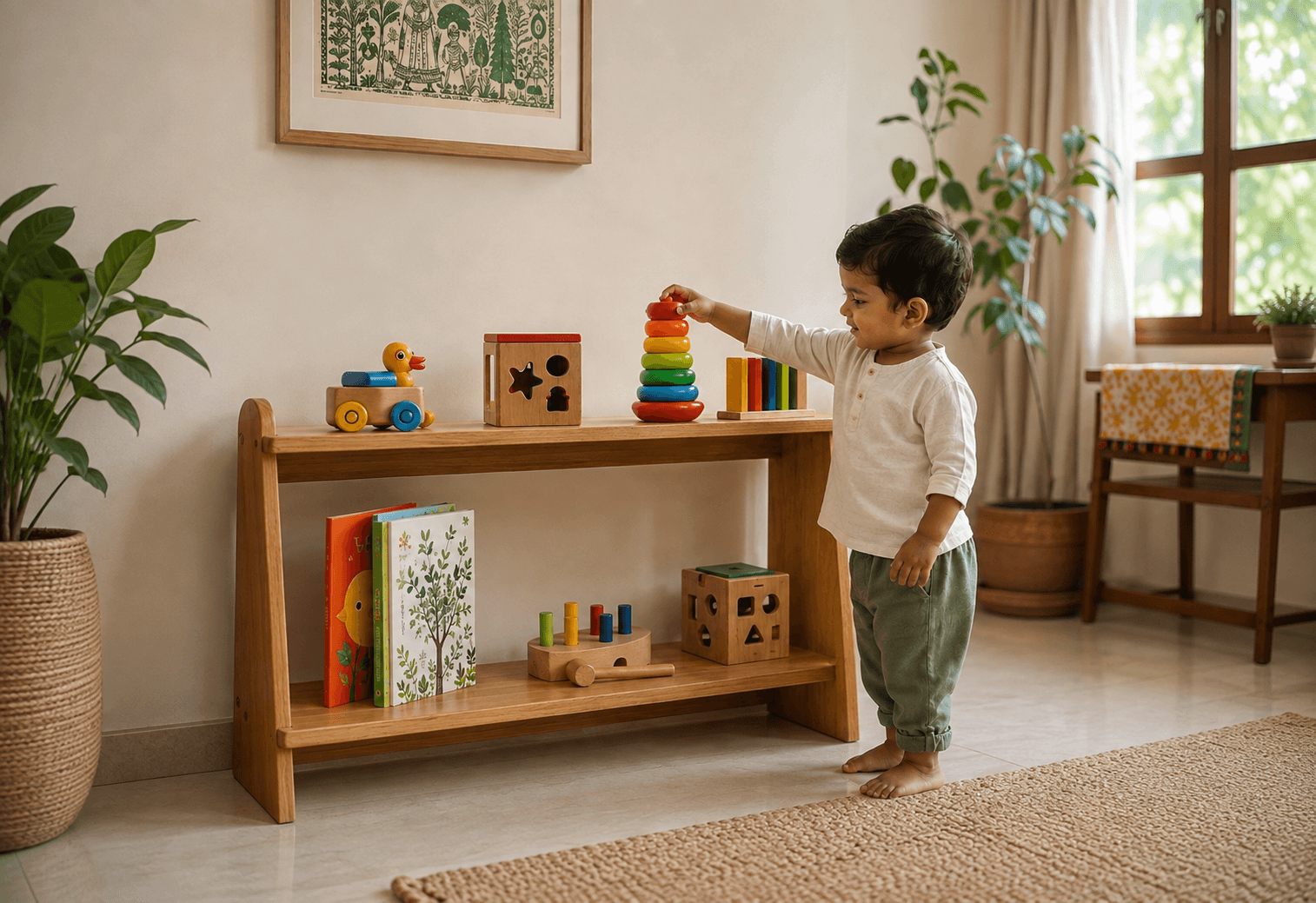
Less clutter means more focus. A calm, tidy play space genuinely helps a child concentrate. When toys are piled in a giant bin, playtime often becomes dump-it-out-and-walk-away. When eight thoughtfully chosen toys sit on a low, visible shelf, your child can see their options, make a choice, and stay with it. This is a core idea in Montessori-style setups, and you don't need a special classroom to borrow it. A shelf and a bit of self-control will do.
There's a quieter benefit too. Rotation supports a fuller range of skills. If you make sure each rotation includes a mix (something for fine motor like puzzles or stacking, something active like a ride-on or ball, something imaginative like pretend-play sets, and a book or two), your child stretches different muscles each cycle instead of sticking to the same three favourites.
How to do toy rotation at home: a step-by-step guide
You can set this up in a single afternoon. Here's the process.
Step 1: Gather everything in one place
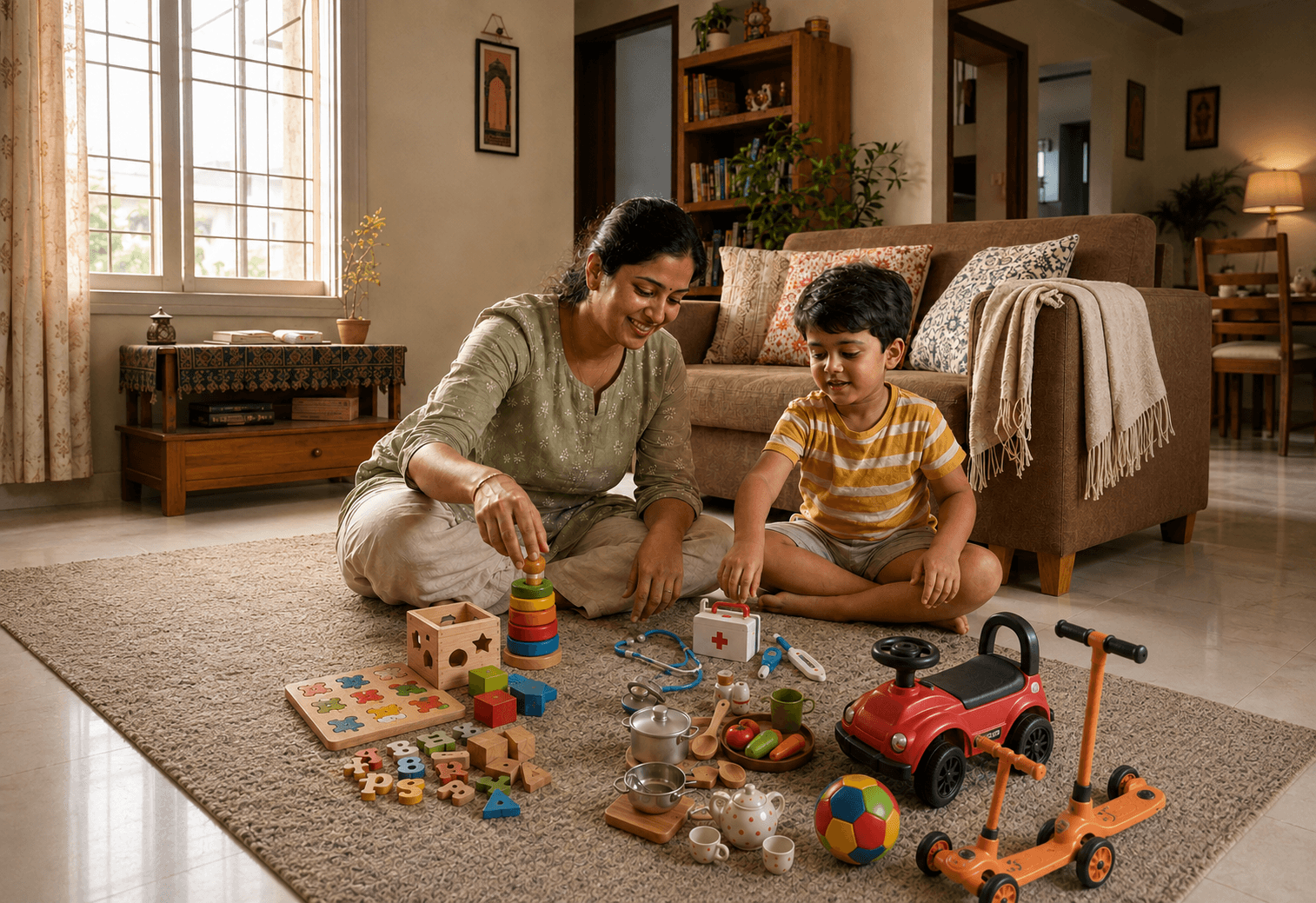
Pull every toy out, yes, from under the bed and the bottom of the cupboard too. You can't rotate what you can't see. This is also a good moment to remove anything broken, missing pieces, or clearly outgrown.
Step 2: Sort into play categories
Group the toys by the kind of play they invite, not by where they came from. A simple set of buckets:
Fine motor and building: blocks, puzzles, stacking rings, threading toys
Active and gross motor: ride-ons, balls, tunnels, balance toys
Pretend and imaginative: kitchen sets, dolls, doctor kits, vehicles
Thinking and STEM: sorting games, simple science kits, board games
Books: always keep some in every rotation
Step 3: Build 3 to 4 balanced sets
Now create three or four rotation sets, each pulling one or two toys from every category. The goal is that any given week, your child has a little of everything, not five puzzles one week and five ride-ons the next. Each set should feel like a complete little world of play on its own.
For most homes, six to ten toys out at a time is the sweet spot. Younger toddlers do well with fewer (four to six); older kids can handle a bit more.
Step 4: Store the rest out of sight
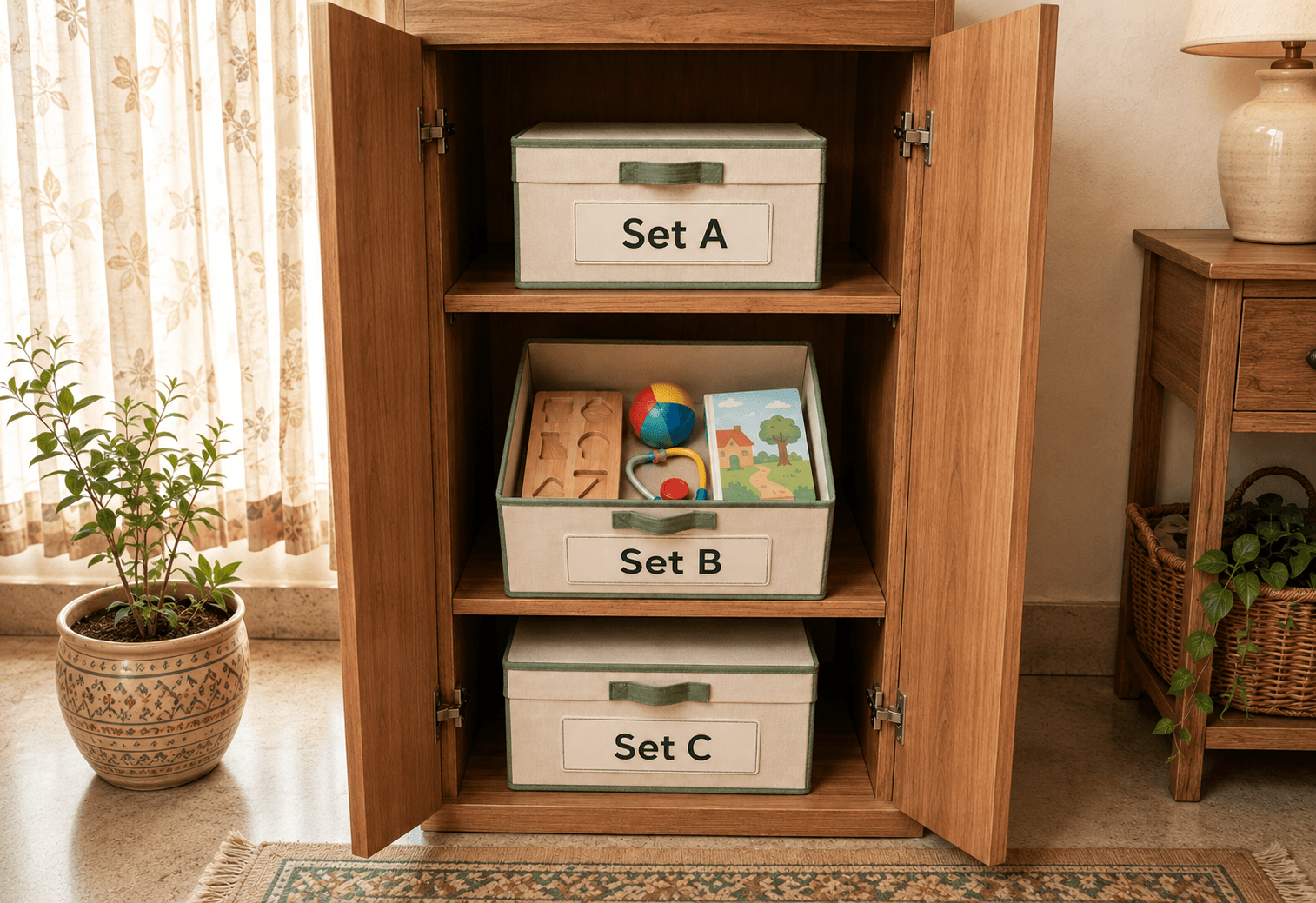
Put the other sets in closed boxes or a cupboard your child can't see into. Out of sight really does mean out of mind here, and that's the whole point. Label the boxes so you're not guessing later, which is especially handy in a compact apartment where storage is already tight.
Step 5: Swap on a rhythm, and watch
Rotate roughly every one to two weeks, or whenever you notice interest fading. You don't need a strict calendar; let your child's interest tell you. If a particular toy is being loved hard, leave it in for the next round. Rotation is a tool, not a rule. Sunday evening makes a nice time for the swap, setting the week up fresh.
How often should you rotate toys?
There's no single right answer, but a good default is every 1 to 2 weeks. Rotate too often and nothing gets the deep, repeated play that builds real skills; rotate too rarely and boredom creeps back. Watch your child: when they start drifting, ignoring the shelf, or asking for "something to do," that's your cue to swap.
Festivals and school holidays are worth planning around too. A fresh rotation right before the Diwali break or the long summer holidays gives you weeks of low-effort, screen-free entertainment exactly when you need it most.
Common toy rotation mistakes to avoid
A few things quietly trip up the system:
Rotating too many toys at once, so the clutter you were trying to escape sneaks back. Keep sets small.
Making every set the same type. A week of only building toys leaves other skills untouched. Balance every set.
Being too strict. If your child is deeply into one toy, don't pull it out on schedule just because it's swap day.
Forgetting to declutter first. Rotating broken or outgrown toys just moves clutter around instead of reducing it.
The honest catch with toy rotation
Here's the thing nobody mentions: toy rotation solves the clutter and boredom problem beautifully, but it doesn't solve the outgrowing problem. Children move through stages fast, and a toy that's perfect at 18 months is often ignored by 30 months. In fact, many kids lose interest in a toy within about 16 days. You can rotate what you own, but you still end up buying, storing, and eventually passing on toys your child has grown past, and good developmental toys aren't cheap in India.
This is where a toy library changes the maths. A service like The EleFant, India's app-based toy and book library, is built around exactly this idea: instead of owning piles of toys and rotating them yourself, you keep a small set at home and swap them for genuinely new, age-appropriate ones as your child grows, all sanitized, delivered, and returned when they're done. You get the novelty and the range of rotation, without the buying, the storage, and the "what do I do with all these now" pile. It's toy rotation without the cupboard full of yesterday's stages.
Whether you rotate your own collection or let a library do the heavy lifting, the principle is the same and it's a good one: fewer toys in front of your child, changed often, beats a mountain of toys they've stopped seeing. Start with a single afternoon of sorting this weekend, and your child's attention span, and your living room, will thank you.
The honest catch with toy rotation
Here's the thing nobody mentions: toy rotation solves the clutter and boredom problem beautifully, but it doesn't solve the outgrowing problem. Children move through stages fast, and a toy that's perfect at 18 months is often ignored by 30 months. In fact, many kids lose interest in a toy within about 16 days. You can rotate what you own, but you still end up buying, storing, and eventually passing on toys your child has grown past, and good developmental toys aren't cheap in India.
This is where a toy library changes the maths. A service like The EleFant, India's app-based toy and book library, is built around exactly this idea: instead of owning piles of toys and rotating them yourself, you keep a small set at home and swap them for genuinely new, age-appropriate ones as your child grows, all sanitized, delivered, and returned when they're done. You get the novelty and the range of rotation, without the buying, the storage, and the "what do I do with all these now" pile. It's toy rotation without the cupboard full of yesterday's stages.
Whether you rotate your own collection or let a library do the heavy lifting, the principle is the same and it's a good one: fewer toys in front of your child, changed often, beats a mountain of toys they've stopped seeing. Start with a single afternoon of sorting this weekend, and your child's attention span, and your living room, will thank you.
FAQs
- What is toy rotation?
Toy rotation is keeping a small set of your child's toys available and swapping it for a different set every week or two, while the rest stay stored out of sight. - How many toys should be out at once?
For most children, 6 to 10 toys is ideal; younger toddlers do better with 4 to 6. The goal is enough variety without overwhelm. - How often should I rotate toys?
Every 1 to 2 weeks works for most families, or whenever you notice your child losing interest. Let their interest guide the timing. - Does toy rotation really reduce boredom?
Yes. A stored toy feels new again when it returns, so children re-engage with things they'd started ignoring, without you buying anything. - At what age can I start toy rotation?
You can start from around 6 to 9 months