
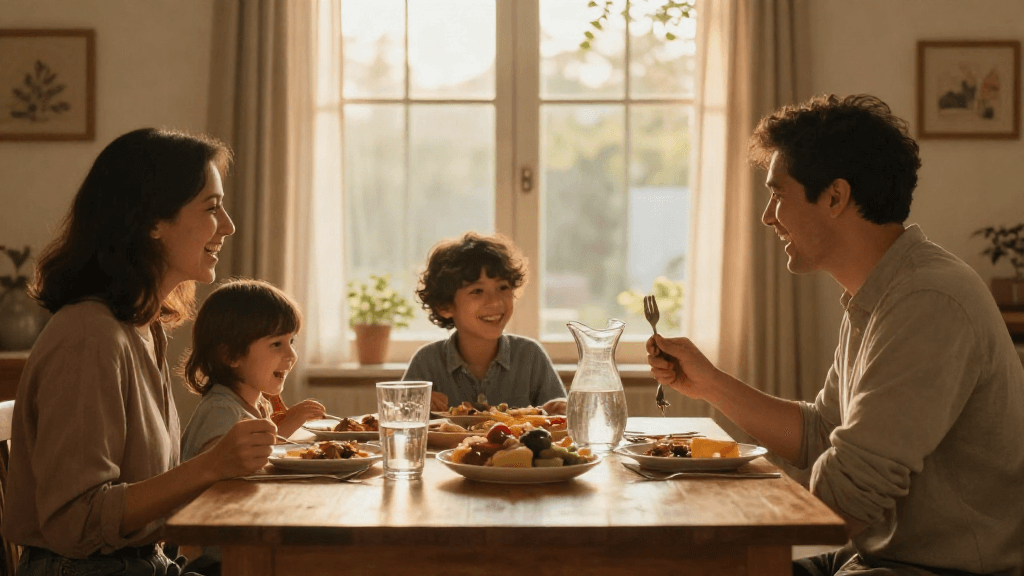
Dinner is the one moment in the day when the whole family sits in the same place with nothing to do but talk. Except that is rarely how it goes. Someone is cutting up food, someone has spilled water, someone lost interest before the second mouthful. That is exactly where a what's for dinner game earns its keep.
A dinner-table game gives the meal a shared focus. It turns five people eating near each other into five people actually eating together. No screens, no props, no prep. And the good news is that you can start tonight with nothing more than the food already on the table.
Why dinner-table games are worth the two minutes they take
Family meals are one of the simplest routines linked to children's language growth and emotional wellbeing. Talking and listening at the table is how children practise new words, learn to take turns, and pick up the small social rules that are hard to teach directly.
Games make that talk happen almost by accident. A child who is asked to describe their food in three words is doing more vocabulary work than they would in a worksheet. A child who has to guess which sibling is telling a tall tale is practising listening, inference, and patience.
They also take the pressure off food. When the focus is the game rather than the plate, fussy eating has less air to breathe. Many parents find that a child who has barely touched dinner suddenly becomes chatty, and then eats a little more.
And there is no kit to buy. That matters in a home already full of toys. If your family's play happens best when it is simple and shared, dinner games fit the same thinking.
Ten quick dinner games that need no props
1. Two Truths and a Tall Tale
Each person says three things about their day. Two are true, one is invented. Everyone else guesses the lie. Great for children aged five and up, and it works even on days when nobody has much news.
2. Best Bit of Your Day
Go round the table and each person names the best moment of their day, and one tricky moment. It is short, it gives quieter children a turn, and it quietly tells you how the week is going.
3. Would You Rather?
Ask a silly choice and let everyone argue for their side. Would you rather have spaghetti for hair or springs for legs? The dafter the question, the better the conversation.
4. Tell Me Three
Pick a category and each person has to name three things in it before they take the next bite. Three things that are round. Three things in the kitchen. Three animals that could never live in your garden.
5. Alphabet Menu
Start with A and go round the table, naming a food for each letter. A is for apple, B is for bread. Keep the pace quick and let younger children repeat the easy ones.
6. Guess My Food
Someone thinks of a food and the others ask yes-or-no questions until they guess it. Is it a fruit? Is it hot? Does it go with chips? It teaches children to build questions rather than shout answers.
7. One-Sentence Story
You start a story with one sentence. The next person adds one sentence, and so on, until everyone has added two. The story will be nonsense. That is the point.
8. Odd One Out
Name four things and ask which one does not belong. Carrot, apple, banana, soap. There is no single right answer, which is what makes it interesting.
9. Colour Hunt
Everyone looks at their own plate and finds something of a chosen colour. Yellow, green, red, brown. For younger children this doubles as a gentle nudge to look at what they are eating.
10. The Compliment Pass
Each person says one thing they liked about the person sitting to their left, from today or any day. Food goes down, faces come up, and dinner ends on a warmer note.
How to adapt dinner games for toddlers
Toddlers cannot hold a long conversation, but they can copy. Keep your version of the game to a single simple turn and let them lead it.
- Choose games with repetition, like Alphabet Menu or Colour Hunt.
- Ask only one question at a time and wait a full five seconds for a reply.
- Let them answer wrongly. The turn matters more than the answer.
- Use your own turn to model what a good answer sounds like.
- Stop while it is still fun. Two happy minutes beats ten tired ones.
If a toddler wanders off mid-game, do not chase it. Let the older children carry on, and your toddler will drift back when they hear the laughing.
Keeping dinner games working for fussy eaters
The golden rule is simple. Never make food the prize and never make it the punishment.
If a child must finish broccoli to take a turn, the game becomes another battleground over dinner. Instead, keep the game completely separate from eating. Everyone plays, whether they have eaten anything or not. The plate is not mentioned.
Other things that help:
- Play before the food lands, so the game is already running when the plate arrives.
- Let a fussy eater hold the role of questioner or judge rather than answering.
- Keep rounds short and stop before anyone declares the game boring.
- Never use food words as the only possible answers unless the child suggests them first.
Over a few weeks, the table stops feeling like a test. That shift alone often loosens a fussy phase, and it costs you nothing but a game.
Make it a habit, not a one-off
Choose just one game, play it for a fortnight, and let it become yours. Families who do this usually find that the game keeps going after the plates are cleared, and that the best conversations of the day happen in that last ten minutes.
Play is how children learn, and it does not always need a toy. But when it does, the EleFant toy library delivers age-appropriate, sanitised toys and books to the door, with unlimited swaps as your child grows. Same idea as a dinner game, really. Keep the play fresh, keep the clutter out, and keep the family talking.
Subscribe Now and bring the next round of play home.