
Toys for Newborn to 6 Months: A Parent's Guide for Indian Families
Quick summary
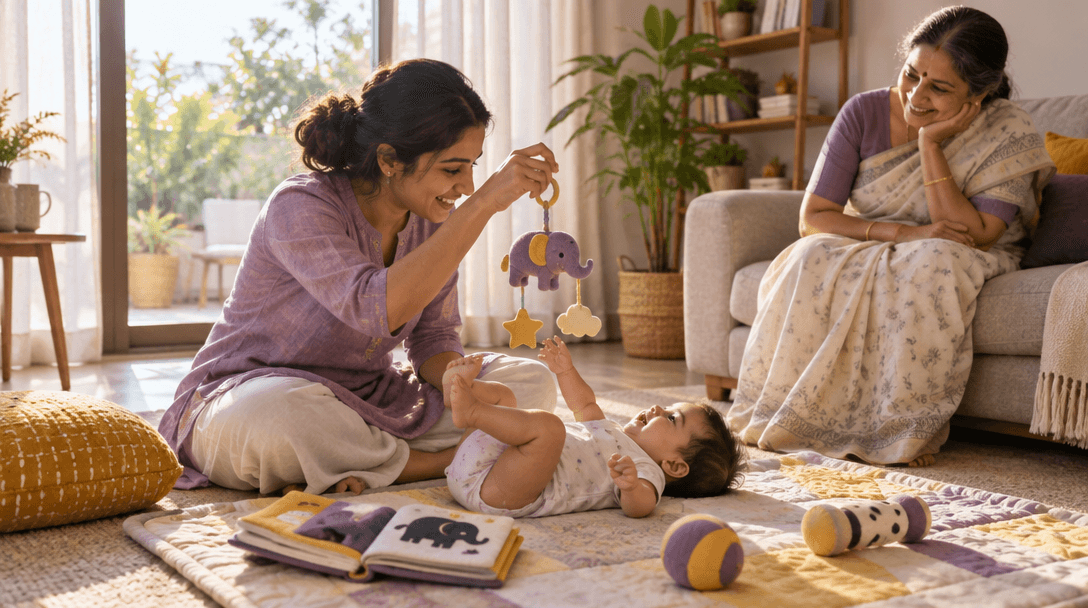
- In the first six months, a small set of toys does more than a room full of them: a play mat, two or three rattles, a teether, a soft book and one musical toy.
- The best toys for newborns match what your baby can do right now. Looking, listening, kicking, reaching and mouthing all come before stacking and sorting.
- Play changes quickly. Toys for newborns to 3 months are very different from what a 5 or 6 month old enjoys.
- Floor time, your voice and everyday household sounds are the real entertainment at this age. Screens add very little.
- Safe materials, easy washing and a simple rotation of two or three toys matter more than how many toys you own.
Introduction
Three weeks into parenthood, the toy corner usually looks like this. A gift box with a rattle. A squeaky plastic toy. A set of blocks marked "3+". And a musical toy that plays nineteen songs at once. Your baby, meanwhile, is happiest staring at the ceiling fan, or at your face.
That is not a problem. In the first six months, babies are not "playing" the way we imagine older children do. They are looking, listening, feeling, and slowly discovering that their own hands and feet belong to them. Toys simply give them something interesting to look at, reach for and hold.
This guide covers what genuinely helps in these early months: the small set of toys worth having, how play changes between 0 and 6 months, a quick buying checklist, safe play ideas you can try at home this week, and age-wise suggestions using the EleFant's official age groups.
What your baby is working on in the first six months
Every baby grows at their own pace, and there is a wide range of what is normal. Your paediatrician is the right person to speak to about your child's development. What follows is simply a picture of what most babies are busy with, so you can choose toys that fit.
0 to 3 months: looking and listening
At this stage, your baby is mostly taking the world in. Eyes learn to follow a slowly moving object. Voices, rhythm and gentle sounds become interesting. Hands brush against things without much control, and tiny fingers slowly uncurl and start to grip.
What helps: things to look at, things to listen to, and safe objects to hold.
3 to 6 months: reaching, holding and mouthing
Now play becomes active. Many babies reach for objects, bring them to the mouth, pass them from one hand to the other, kick at things above them, and start rolling or sitting with support. They also begin to understand cause and effect: shake this, and it makes a sound.
What helps: light, easy-to-grip toys that reward a grab with a sound, a movement or a nice texture.
The toys worth having in the first six months
You do not need all of these on day one. Add them as your baby's skills change.
1. A play mat or newborn play gym
A play mat or newborn play mat gym gives your baby a clean, comfortable place for floor time, which is where most early learning happens. A simple mat is enough. If you choose one with arches, look for hanging toys that are soft, securely attached, and positioned where your baby can actually see or swipe at them.
Keep the mat easy to wipe or wash. Between dust, spilled milk and the occasional nappy surprise, washability matters more than the print.
2. High-contrast cards and soft cloth books
Newborn eyes are drawn to strong contrast. A few high-contrast picture cards propped up at floor level, or a soft cloth book, work well in the first three months. Later, the same book becomes something to chew on and turn over, which is exactly how early book habits begin.
3. Rattles and gentle shakers
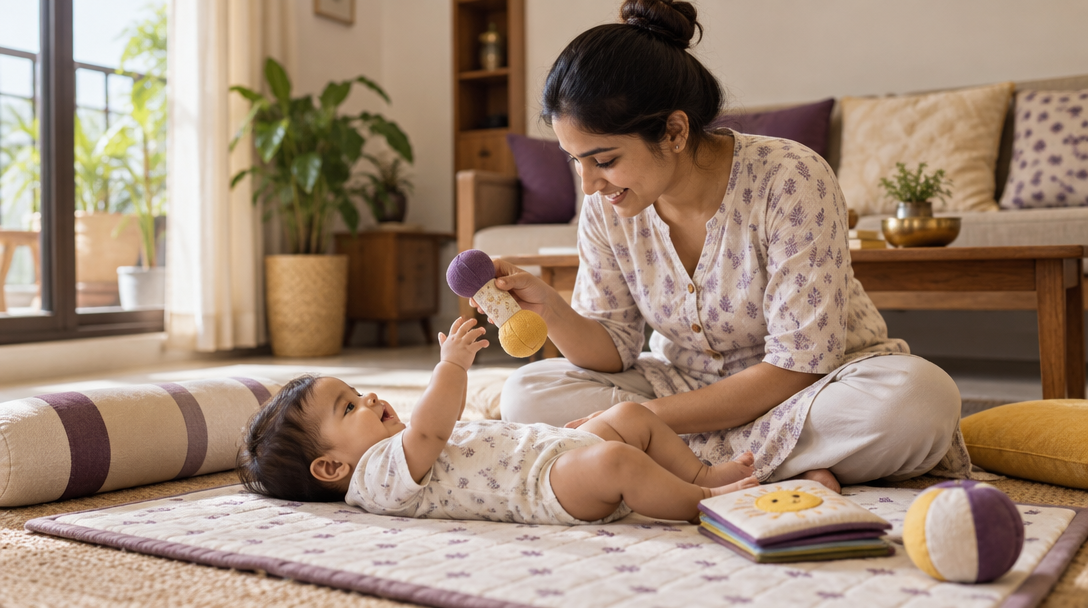
A newborn rattle is probably the most useful toy in this entire list. It is light, it is easy to grip, and it teaches the link between my hand moved and sound happened. Choose one with a slim handle for small hands, and check that the sound is soft rather than shrill.
4. Teethers and safe mouthing toys
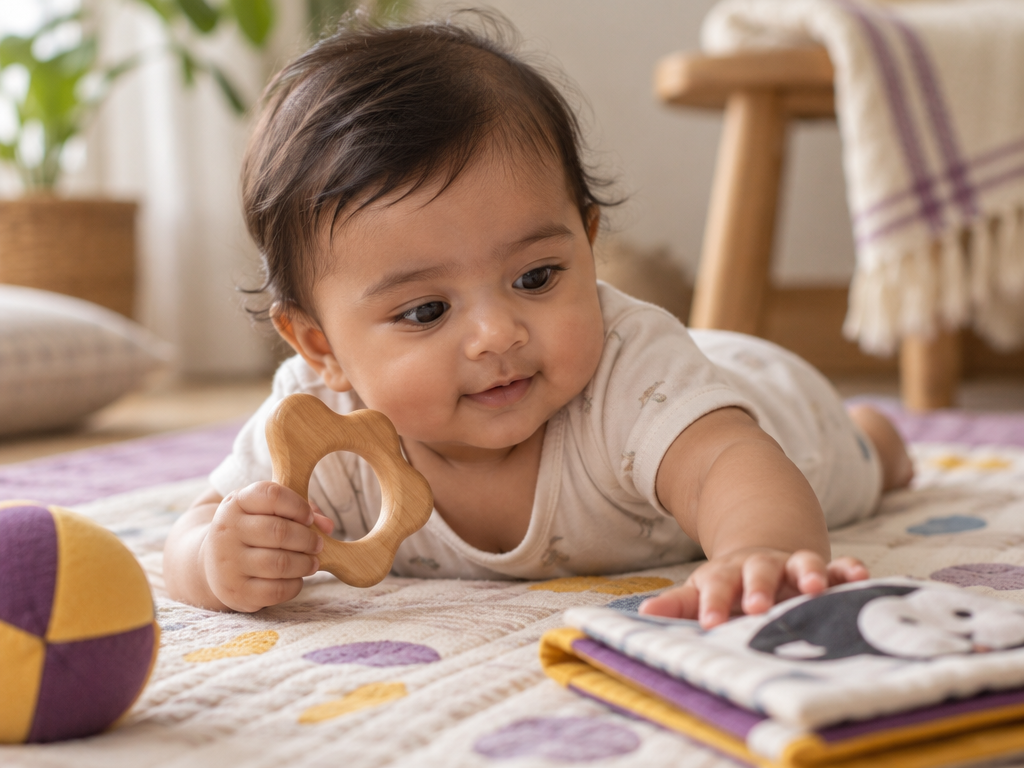
Between three and six months, most babies put everything in their mouth. Newborn teething toys with different textures, a wooden teether with a smooth food-safe finish, or a chilled silicone teether give them something safe to gnaw on. Avoid anything with loose parts, water that can leak, or a painted surface that can flake.
5. One or two soft toys
Soft toys for newborns are lovely for comfort, cuddles and photographs. Two is plenty. Pick one with stitched features rather than glued-on eyes or buttons, and keep it out of the cot while your baby sleeps.
6. Musical toys
Musical toys for newborns earn their place when the sound is soft and the interaction is simple. A small shaker, a soft bell or one gentle musical toy for a fixed song routine at bedtime often works better than a gadget with a dozen modes. Test the volume before you buy. Nothing should startle your baby.
7. Bath time toys
A couple of floating newborn bath toys or a soft squeeze toy turn bath time into a daily play session with warm water, which is a rich sensory experience on its own. Rinse and dry them properly after every bath, and squeeze out the water, so nothing stays damp inside.
How to choose a toy for a baby under six months
A five-point check that saves a lot of returns.
- Age fit. Does the toy match what your baby can do this month, not what an older child can do? A toy that is too advanced just sits in a box.
- Size and shape. Nothing detachable should be small enough to swallow. As a simple rule, if a part fits inside a toilet roll tube, it is not for a baby who mouths everything.
- Material and finish. Look for non-toxic, baby-safe paints, smooth sanded edges, food-grade silicone or well-finished wood. Avoid anything with a strong chemical smell.
- Washability. In an Indian home, dust, humidity and monsoon damp are real. If you cannot wipe it, wash it or sun-dry it easily, think twice.
- Sound level. A toy should be pleasant at arm's length from your ear. If you wince, your baby will too.
What you can safely skip in the first six months
- Screens. There is little a screen gives a baby under six months that your face, your voice and a rattle do not give better.
- Baby walkers. Most child development experts advise against baby walkers, and floor time is far more useful for a baby learning to move. If you already have one, ask your paediatrician about it.
- Big battery-powered toys. They are usually too heavy, too loud and too complicated for this age.
- A shelf full of toys. Brain development toys and infant learning toys sound promising, but a baby does not learn faster from more toys. A few good ones, offered one at a time, work better.
Practical play ideas for Indian homes
You do not need a playroom. You need about fifteen minutes, a clean floor and a little attention.
- Post-bath floor time. Spread a cotton mat over the dhurrie in the living room, and let your baby kick freely. This is the easiest daily play session you can build into a routine.
- Narrate your chores. While cooking, name what you are doing: "Now we are washing the dal." Your voice, in your own language, is the best infant learning toy there is.
- Peekaboo with a dupatta. A soft cotton dupatta or a muslin cloth makes an excellent hiding game from about four months, and it costs nothing.
- Kitchen band, supervised. A steel bowl and a spoon, well away from the stove and hot vessels, is a brilliant cause-and-effect toy for a five month old.
- Mirror time. Lie your baby on the mat beside a safe, well-fixed mirror. Watching that other baby move is endlessly fascinating.
- Grandparents on a call. Ask your parents to sing or hum a familiar song on a video call. Familiar voices from far away give your baby real listening practice.
- Rotate, do not pile. Keep two or three toys within reach for a week, and put the rest away. Swap them out when interest drops. This simple habit is how families keep fewer toys and still keep play interesting. (Learn more in our guide to the toy rotation system.)
Safety first, always: supervise play, keep toys out of the cot while your baby sleeps, avoid cords, strings and ribbons near the cot, check teethers and cloth toys often for wear, and wash anything that goes into the mouth more often than you think you need to.
Age-wise toy recommendations
All Ages
Books you read aloud. Rhythm and your voice work for every age group in the house, from a newborn to a twelve year old. Cloth and board books are the version that survives a baby's mouth.
0–1 Years
- Newborn play mat or play gym for daily floor time
- High-contrast picture cards and cloth books
- One or two light rattles
- Teethers with different textures, including a wooden teether
- Two soft toys with stitched features
- One gentle musical toy or soft shaker
- A couple of floating bath toys
1–3 Years
Toys your baby will grow into, so it helps to plan ahead instead of buying twice: stacking cups and rings, wooden blocks, a simple shape sorter, a push-along wooden walker, first board books, and wooden toy cars. Toys for preschool play, like a wooden kitchen set or a small doll house, also start getting attention in this band.
Why a toy library suits the first year
Here is the honest problem with baby toys. A newborn play gym is interesting for about three months. A rattle stays interesting for a few weeks after that. By six months, the toys that filled the living room in January are staring at you from a corner in June.
A toy library solves that, which is exactly why the EleFant exists. It is a mobile app based toy library for children aged 0 to 12, where curated, age-appropriate toys are delivered to your door and swapped as your child grows. Instead of buying a toy your baby will outgrow in a season, you borrow it, play with it, and send it back for the next stage. The library also includes books, and every toy is cleaned and checked before it reaches you. For a family in a small flat, this quietly solves two problems at once: toy clutter, and the cost of toys that only last a few months. You can see how it works at theelefant.ai.
FAQs
How many toys does a newborn actually need?
Two or three, plus something to lie on. A rattle, a high-contrast card or cloth book, and a soft toy are enough in the first three months. Add more as your baby starts reaching and mouthing.
Which toys are best for a 1 month old in India?
Keep it simple: high-contrast cards, one soft rattle, a cloth book, and a comfortable play mat for supervised floor time. At one month, your face and your voice are still the best entertainment.
Are plastic toys safe for newborns?
Many plastic toys are perfectly safe if they are made for the age group, free from sharp edges, and made with non-toxic, baby-safe materials. Check the label, avoid strong chemical smells, and replace anything that cracks, flakes or leaks.
Does my baby need a baby walker?
Most child development experts advise against walkers, and floor time is more useful for a baby learning to roll, sit and eventually move. Speak to your paediatrician before buying one.
How often should I clean my baby's toys?
Anything that goes into the mouth should be cleaned very often, ideally daily. Wipe hard toys, wash cloth toys, and let them dry fully in the sun. Teethers and bath toys need the most attention, especially in humid weather.
Is it too early to read to my baby?
No. Reading aloud to a newborn is not about understanding words. It is about hearing the rhythm of language and sharing a calm moment with you. Cloth and board books let your baby join in safely.
The bottom line
Your baby does not need a big toy collection in the first six months. They need a safe mat to move on, a few easy-to-grip things to reach for, something safe to mouth when teething starts, and plenty of your voice. Buy less, pick better, and rotate what you have.
If you would rather not buy every stage and store what your baby outgrows, the EleFant lets you borrow curated, age-appropriate toys and swap them as your child grows. Download the EleFant app to see what is available for your child's age.