



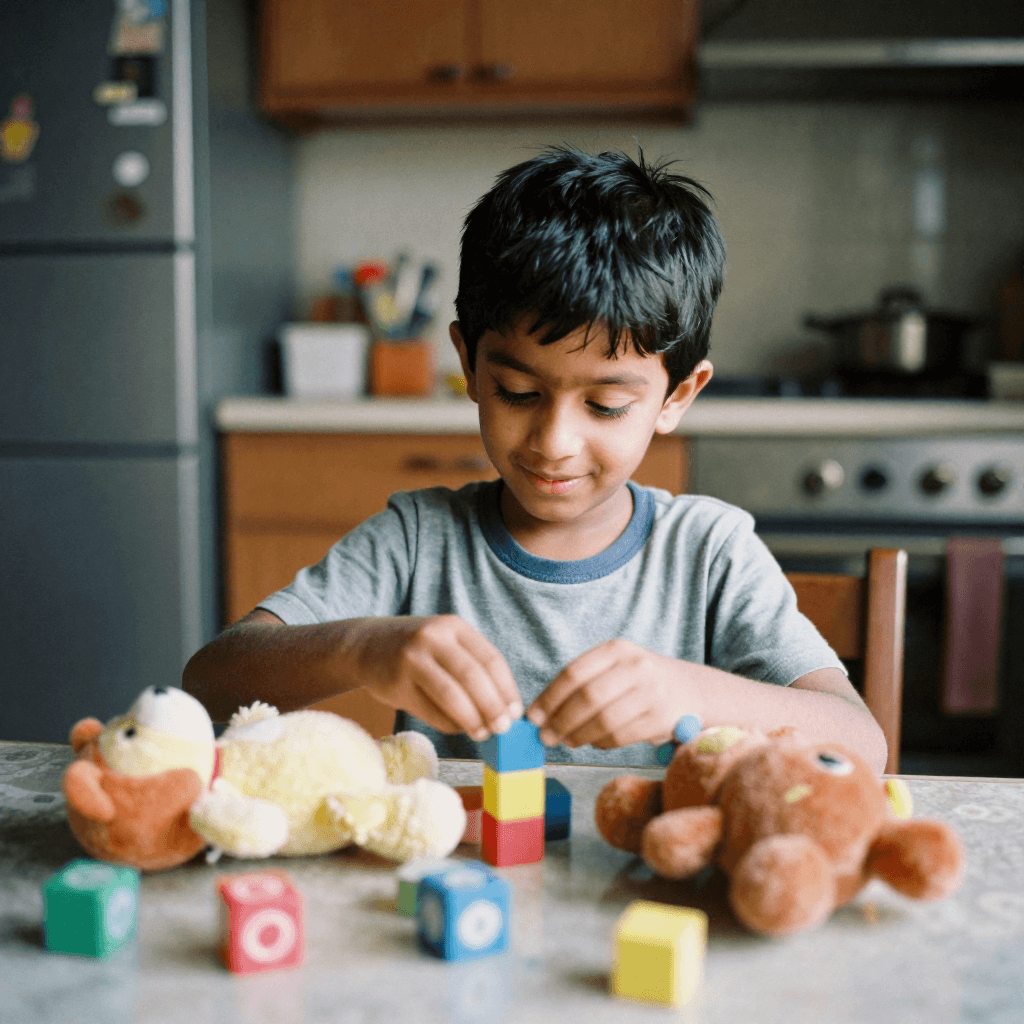
The Science of Play and Brain Development
The brain develops most rapidly in early childhood, with nearly 90% of brain development by age five and critical neural connections forming through the first 8 years. These years are crucial because the brain is highly shaped by experience. Hands-on, joyful play—supported by the right toys—helps children build thinking, emotional, motor, and problem-solving skills. The quality of play in these early years lays the foundation for lifelonglearning and development.
Play stimulates multiple areas of the brain at once:
- Motor regions when children grasp, stack, or push toys
- Language centres when they talk, sing, or narrate stories
- Emotional areas when they feel joy, frustration, or excitement
- Cognitive regions when they solve problems or imagine scenarios
When children play, neurons form new connections. The more meaningful and engaging the play, the stronger these connections become.
How Toys Support Cognitive Skills
Toys serve as instruments for children to learn about how the world works. Even simple toys can have a powerful impact on thinking and reasoning skills.
Building blocks teach children about concepts like balance, symmetry, and spatial cognition as well. These sorting toys are a great way to develop early math skills such as counting, number recognition, patterning, and matching.
It’s not about complexity, it’s interaction. Toys that foster children’s abilities to think and experiment, then try again, help develop:
- Attention span
- Logical reasoning
- Problem-solving abilities
- Decision-making skills
When children experience and overcome challenges during play, their brains learn to be resilient and persistent.
Emotional Development Begins On The Play Mat
Play is also one of the safest ways for kids to process emotions. Children communicate hidden emotions through play, for which they sometimes have no words.
A child comforting a teddy bear is also practising empathy. A pretend argument between action figures might be a way to process the experience of conflict. When children role-play different situations, they learn emotional regulation – how to manage anger, disappointment, excitement, and fear.
Toys provide emotional rehearsal. They allow children to act out, find meaning, and feel in control. This emotional practice supports:
- Self-confidence
- Emotional intelligence
- Stress management
- Healthy expression of feelings
Young children who participate in imaginative play develop a good sense of balance in their emotional development.
Pretend play encourages children to:
- Form sentences
- Ask questions
- Practice tone and expression
- Understand social cues
Even solitary play can be language-heavy. A child playing alone and talking to themselves is indeed sorting their thoughts and running through how to speak. And this “self-talk” is a crucial step in mastering the ways of speaking clearly with others.
Social Skills Begin with Shared Toys
Playing with others teaches skills that no worksheet can replicate. For example: Sharing toys, playing games, taking turns at play activities, negotiating rules, and resolving conflicts are all part of the natural experience of playing.
Through social play, children learn:
- Cooperation and team work
- Patience and fairness
- Respect for others’ perspective
- Conflict resolution
Board games, group activities and imaginary play teach children how to relate to others. These early lessons are building blocks for strong friendships and confidence in social situations as we grow up.
Fine and Gross Motor Skills in Action
Physical interaction with toys directly shapes brain-body coordination. Fine motor skills develop through stacking, turning pieces, and grasping small objects. Gross motor skills improve when children push, pull, throw, crawl, or ride.
The exercises build neural pathways that help with focus, writing readiness, coordination, and general physical confidence.
Imagination: The Brain’s Creative Gym
Imaginative play is where creativity is born. When a child turns a box into a spaceship or pretends a spoon is a microphone, their brain engages in abstract and flexible thinking.
It’s this kind of play that helps children adjust to new circumstances, try out ideas, and develop creative problem-solving skills that are useful throughout their lives.
Where Toy Subscription Fits In: Supporting Continuous Brain Growth
Kids quickly outgrow toys — not just in size but also in development. A child’s future challenge may be a child’s boring present. Entertoy subscription modelsand their important role in brain development.
A toy subscription ensures that children always have access toage-appropriate ,development-focused toys that match their current learning stage. As a child grows, toys can be swapped to introduce new challenges, skills, and experiences.
Toy subscription supports brain development by:
- Providing variety that keeps the brain curious and engaged
- Introducing new cognitive, motor, and imaginative challenges regularly
- Preventing overstimulation from too many toys at once
- Encouraging deeper, focused play with fewer but better toys
By refreshing toys periodically, children continue to form new neural connections instead of repeating the same patterns. This keeps learning active, playful, and progressive.
Why Too Little Play Can Be Harmful
In our modern, busy world, playtime is replaced by screens, structured schedules, or academic anxiety. But curtailing play inhibits how children naturally learn and absorb information.
Without enough play, we can become more distracted, stressed, antisocial , and less creative. Play is not a reward for learning — it is how young children learn best.
Selecting Toys That Really Help Brain Development
The best toys aren’t always the shiniest and most expensive. They are the ones that beckon exploration, imagination, and problem-solving.
Brain-supporting toys:
- Allow multiple ways to play
- Grow with the child’s abilities
- Encourage creativity and interaction
- Encourage users to engage, not just consume
Toy subscription services can do a great job of selecting toys based on developmental milestones, making it easier for parents to choose wisely without the pressure of buying, buying, and more buying.
Play Today, Strong Minds Tomorrow
Play shapes the brain in ways that can last a lifetime. Through toys — or access to the right toy at the right time — children develop thinking and emotional skills, social and physical confidence, creativity, and coordination.
Play is not optional. It is essential. And by making intelligent choices about toys — and embracing less concrete options, like toy subscriptions — parents can help their children’s brains develop in a way that is joyful, sustainable, and deeply valuable. At the elefant, we provide completely safe, sanitised toys. Parents do not have to worry about their child damaging or losing the toys, as we’ve got you covered.